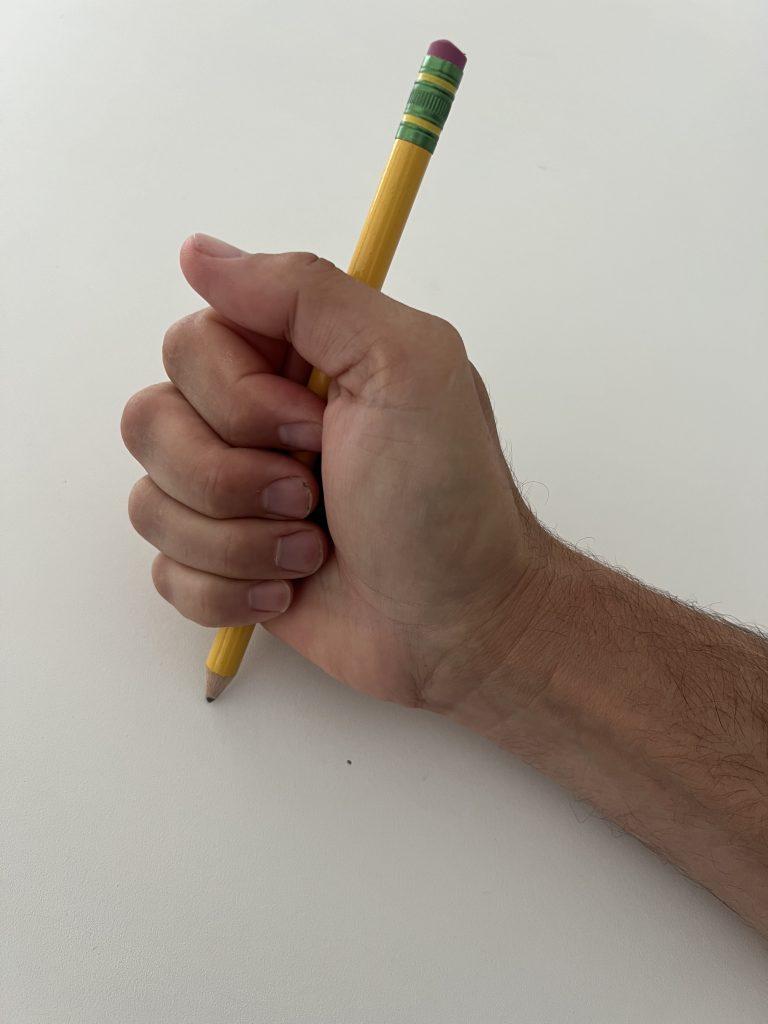
Palmar Supinate Grasp (Fisted Grasp)
Description:
The pencil or crayon is held in the fist, with the thumb positioned on top. Movement comes primarily from the shoulder and arm rather than the fingers.
Age commonly seen:
12–18 months
Functional or not:
It is an expected early grasp for scribbling and early mark-making. It would be considered immature if it persists substantially beyond the expected developmental period, particularly as more refined pencil control is required.

Digital Pronate Grasp
Description:
The pencil is held in the fingers with the palm facing downward. Movement comes primarily from the arm and forearm rather than refined finger movements.
Age commonly seen:
2–3 years. Both AOTA and pediatric OT resources place digital pronate in this developmental period.
Functional for older children?
Generally no. It is an appropriate developmental grasp at ages 2–3 but is considered an immature grasp pattern when retained in an older child. Because pencil movement relies heavily on the arm rather than refined distal finger movements, it can reduce the precision and efficiency needed for increasingly complex handwriting tasks.
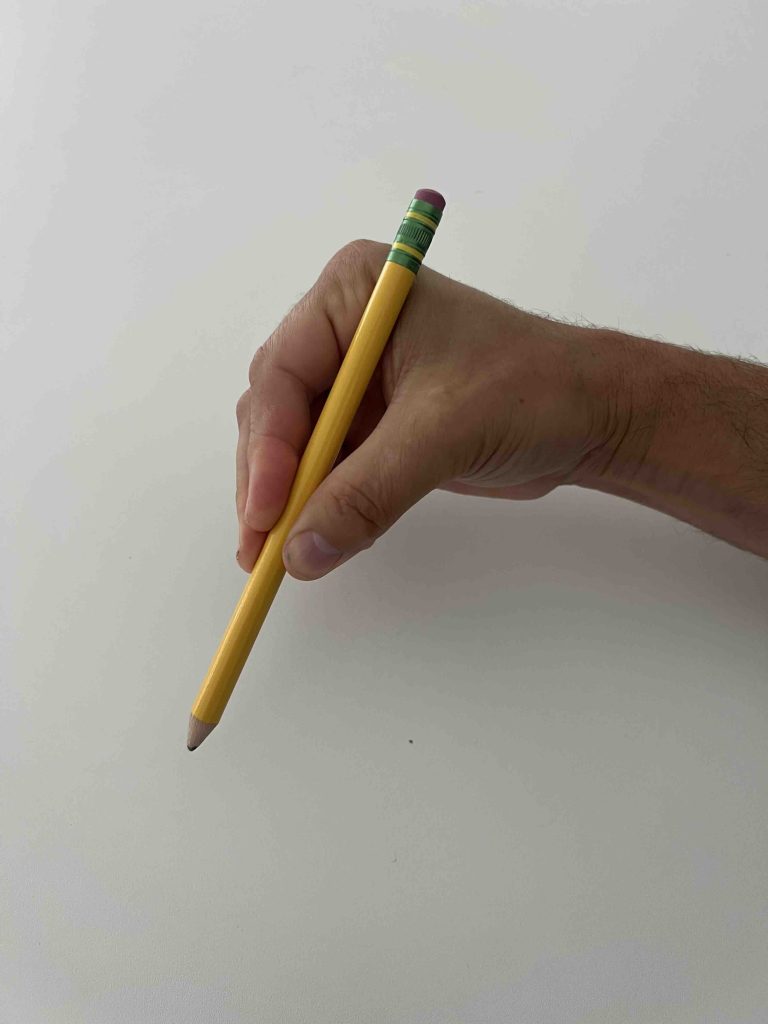
Brush Grasp
Description:
The pencil is held with the fingers, with the upper end of the pencil positioned against the palm. The hand is pronated, and movement comes primarily from the arm and wrist rather than refined finger movements.
Age commonly seen:
Approximately 3–4 years. I would not retain your current 2–3 years. Schneck & Henderson studied children beginning at age 3, and brush grasp is classified among the early/primitive grasp patterns. Importantly, grasp development is variable rather than a rigid sequence.
Functional for older children?
Generally not considered an efficient mature handwriting grasp. It relies substantially on proximal arm/wrist movement rather than refined distal finger control. If it persists in a school-age child, I would assess whether it is associated with reduced precision, speed, endurance, or comfort rather than declaring it dysfunctional solely from its appearance.

Quadrupod Grasp
Description:
The pencil is held with four digits: the thumb, index, middle, and ring fingers. The four-finger configuration provides additional support compared with a tripod grasp. Depending on the child, movement may be more static or may become refined and finger-directed.
Age commonly seen:
Approximately 3–4 years as an emerging four-finger grasp pattern. Mature quadrupod variants may continue into later childhood and adulthood.
Functional for older children?
Yes, it can be fully functional. A quadrupod grasp should not be considered abnormal simply because four fingers contact the pencil. Mature dynamic and lateral quadrupod grasps have been shown to produce handwriting speed and legibility comparable with traditional mature tripod grasps.
For an older child, concern is more appropriate when the grasp remains inefficient, such as excessive proximal movement, excessive force, pain, fatigue, poor control, or difficulty maintaining handwriting speed and legibility. A 2023 scoping review concluded that the overall relationship between pencil grasp and handwriting performance remains inconclusive, although inefficient grasps may contribute to fatigue or reduced legibility in some children.

Cross Thumb Grasp
Description:
The fingers are loosely flexed into the palm. The pencil is held against the index finger, while the thumb crosses over the pencil toward the index finger. The forearm is supported on the writing surface, with movement occurring through the fingers and wrist. This matches the Schneck and Henderson definition.
Age commonly seen:
Approximately 3–6 years, most characteristically during the preschool years. Schneck and Henderson classified cross thumb as a transitional grasp. Their earlier work reported a mean age of about 4.6 years, and their larger developmental study found it across several preschool age groups.
Functional for older children?
Potentially, but it is not classified as a mature grasp pattern. The crossed thumb can restrict the open web space and may reduce efficient distal manipulation of the pencil. However, the presence of a cross thumb grasp alone does not establish handwriting dysfunction.
For an older child, it becomes clinically relevant when associated with pain, excessive pressure, fatigue, reduced speed, poor legibility, or difficulty manipulating the pencil. I would not recommend changing an established grasp solely because the thumb crosses over the pencil.
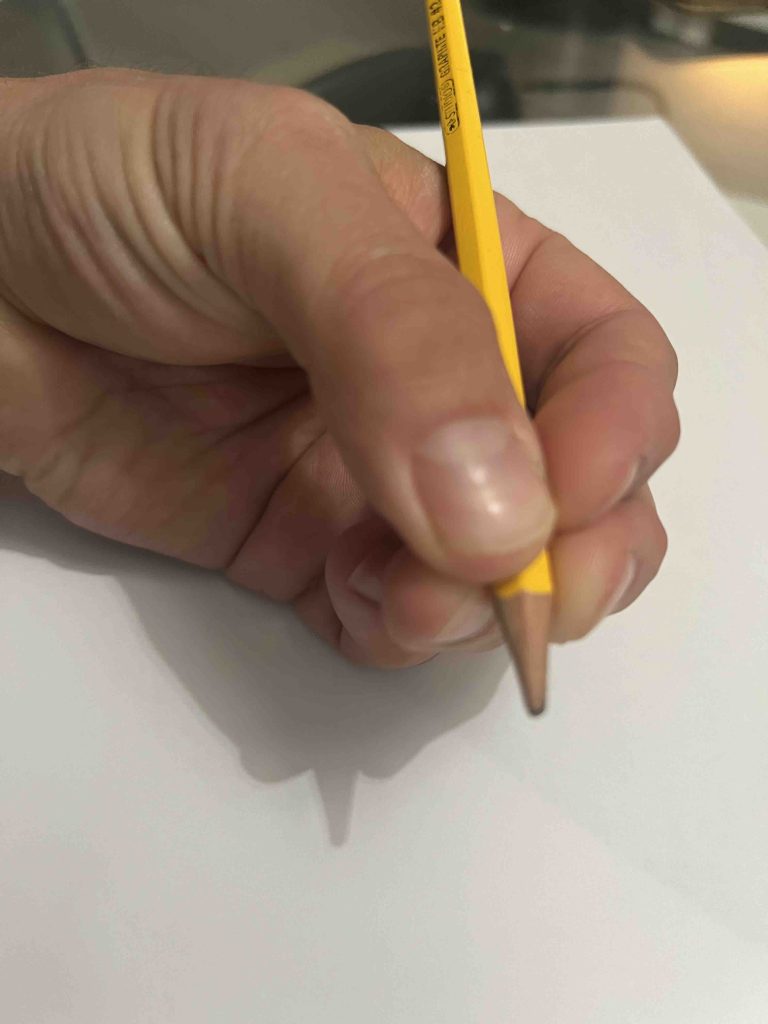
Dynamic Quadrupod Grasp
Description:
The pencil is controlled by the thumb, index, and middle fingers, with the ring finger providing additional support. Small, coordinated finger movements control the pencil while the wrist and forearm remain relatively stable.
Age commonly seen:
Approximately 4–6 years and older. It is a mature grasp pattern that may persist throughout childhood and adulthood. I would present this as an approximate developmental range rather than a rigid milestone.
Functional for older children?
Yes. This is considered a mature, functional handwriting grasp. Research comparing dynamic quadrupod, dynamic tripod, lateral tripod, and lateral quadrupod grasps in Grade 4 children found no significant differences in handwriting speed or legibility attributable to these mature grasp patterns.
A separate study using a 10-minute continuous copying task intended to induce fatigue also found no advantage of dynamic tripod over dynamic quadrupod or the other mature grasp patterns for handwriting speed or quality.
For your website, I would therefore not suggest correcting a dynamic quadrupod simply to achieve a tripod grasp. Intervention would make sense only if the child’s actual grasp is associated with pain, excessive effort, fatigue, poor control, reduced speed, or poor legibility.

Static Tripod Grasp
Description:
The pencil is held between the thumb and index finger and supported by the middle finger. The fingers remain relatively still, with pencil movement coming primarily from the wrist and forearm.
Age commonly seen:
Approximately 3–4 years. It is a normal immature/transitional grasp as children develop more refined pencil control. Pencil-grasp development varies considerably among children.
Functional for older children?
Potentially, but not considered a mature grasp. If a static tripod persists into the school years, it should not automatically be considered dysfunctional. The important question is whether the child can write with adequate legibility, speed, control, comfort, and endurance.
Because the fingers remain relatively static, the grasp provides less distal finger manipulation than a dynamic tripod. However, evidence does not establish that the grasp itself necessarily causes poor handwriting. Intervention is more appropriate when the grasp is associated with an actual functional problem, such as pain, fatigue, excessive effort, reduced speed, or poor legibility

Interdigital Brace Grasp
Description:
The pencil is stabilized between adjacent fingers, typically the index and middle fingers, rather than resting primarily in the thumb-index web space. The thumb provides additional stabilization.
Age commonly seen:
No established developmental age range. Unlike developmental grasps such as the digital pronate or static tripod, the interdigital brace is generally described as an alternative or compensatory grasp and may be seen in older children and adults.
Functional for older children?
Yes, it can be functional. An interdigital brace grasp should not automatically be considered inefficient or require correction. Alternative grasp patterns can provide adequate stability and handwriting performance.
It becomes clinically relevant when associated with pain, fatigue, excessive pressure, reduced speed, poor legibility, or difficulty manipulating the pencil. If handwriting performance is adequate and the grasp is comfortable, changing an established interdigital brace may provide little benefit.

Dynamic Tripod Grasp
Description:
The pencil is controlled by the thumb, index, and middle fingers, with the middle finger providing support. The pencil rests in the thumb-index web space, and writing is controlled primarily through small, coordinated finger movements.
Age commonly seen:
Approximately 4½–6 years and older. It is a mature grasp pattern commonly established as fine motor control develops during the preschool and early school years.
Functional for older children?
Yes. This is a mature and highly functional handwriting grasp. It supports refined pencil control and is commonly seen in school-age children and adults. However, it is not demonstrably superior to other mature grasp patterns. Research comparing the four common mature grasps found no significant differences in handwriting speed or legibility.
If a child uses a comfortable dynamic tripod and demonstrates adequate legibility, speed, control, and endurance, there is generally no reason to modify the grasp.
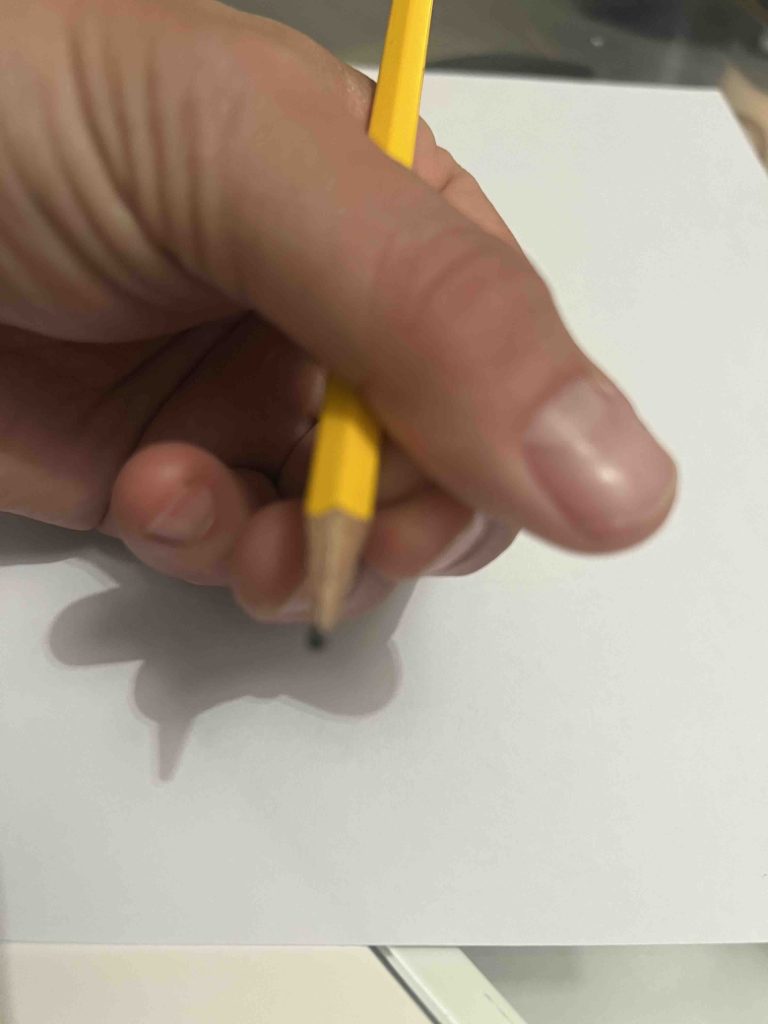
Lateral Quadrupod
- Four digits participate in pencil control/support rather than the three-digit configuration of a tripod.
- The pencil is stabilized along the lateral aspect of the index finger, with the thumb adducted across/against the pencil.
- The thumb position distinguishes it from a dynamic quadrupod, where the thumb is more opposed.
- The ring finger participates in supporting the pencil. This four-digit configuration is consistent with the quadrupod definition.
Lateral quadrupod is considered a mature, functional grasp variation. Research in school-age children identifies dynamic tripod, lateral tripod, dynamic quadrupod, and lateral quadrupod as four mature grasp patterns. They produced comparable handwriting speed and legibility in Grade 4 children.
The classic Schneck and Henderson developmental study examined children from 3.0 through 6.11 years and found increasing use of mature grasp patterns with age, reaching 90% in the oldest children. However, that study’s developmental classification emphasized dynamic and lateral tripod patterns, so I would not claim that lateral quadrupod normally “develops at age X” based on that study.